
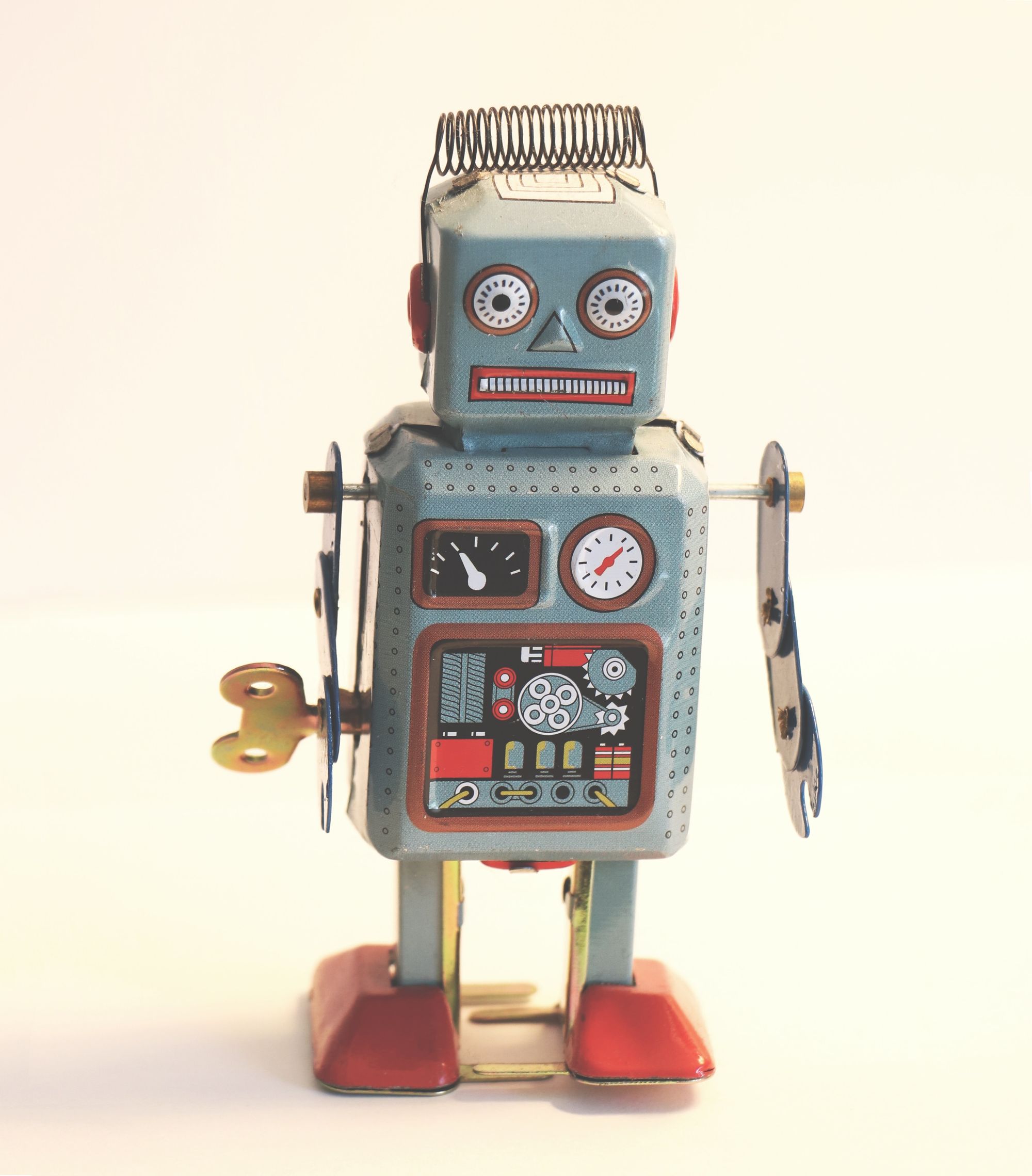
 Photo by Rock'n Roll Monkey on Unsplash
Robo War: Detroit is becoming a hub for cutting-edge robot technology and AI innovations
By Marcus Washington | Reading Time: 4 minutes
This article explores Detroit's emergence as a hotspot for advanced robotics and AI development, particularly for applications ranging from manufacturing to defense. It highlights key local companies pioneering robot designs that integrate AI to navigate complex environments and perform tasks with precision. The city’s industrial heritage is evolving by embracing automation and intelligent machines, fostering innovation hubs and workforce transformation. The piece emphasizes how these technologies are shaping economic opportunities and revolutionizing traditional production processes in Detroit.
 Photo by Juanjo Jaramillo on Unsplash
AI Tools Reshape Cybersecurity Landscape, Impacting Junior Roles
By Sarah Morgan | Reading Time: 5 minutes
This article examines how AI-powered cybersecurity tools are transforming the industry, automating many routine security tasks and enhancing threat detection. It details the mixed impact on junior cybersecurity professionals, whose roles are evolving due to automation reducing manual work but also creating demand for more advanced skills. The discussion covers how AI tools improve efficiency yet require human oversight for complex decision-making and ethical considerations. It calls for continuous learning and upskilling for newcomers to remain relevant in this dynamically shifting domain.
 Photo by
 Consumer Skepticism is Slowing Progress Toward a Circular Economy
By Emily Summers | Reading Time: 4 minutes
This article investigates how consumer doubts about product sustainability claims are hindering the circular economy's growth. It notes that despite advances in sustainable materials and recycling technologies, mistrust and lack of transparency lead many consumers to question circular initiatives. The piece underscores the necessity for brands to enhance communication, demonstrate genuine impact, and build trust to drive broader adoption of circular practices. It also highlights the role of innovation and stakeholder collaboration in overcoming skepticism and enabling a more sustainable consumption model.
🌙 NASA - Best Photo from Last Week
Hubble Snaps a Stunning Galaxy Clusters Portrait

A massive, spacetime-warping cluster of galaxies is the setting of today’s NASA/ESA Hubble Space Telescope image. The galaxy cluster in question is Abell 209, located 2.8 billion light-years away in the constellation Cetus (the Whale).
This Hubble image of Abell 209 shows more than a hundred galaxies, but there’s more to this cluster than even Hubble’s discerning eye can see. Abell 209’s galaxies are separated by millions of light-years, and the seemingly empty space between the galaxies is filled with hot, diffuse gas that is visible only at X-ray wavelengths. An even more elusive occupant of this galaxy cluster is dark matter: a form of matter that does not interact with light. Dark matter does not absorb, reflect, or emit light, effectively making it invisible to us. Astronomers detect dark matter by its gravitational influence on normal matter. Astronomers surmise that the universe is comprised of 5% normal matter, 25% dark matter, and 70% dark energy.
Hubble observations, like the ones used to create this image, can help astronomers answer fundamental questions about our universe, including mysteries surrounding dark matter and dark energy. These investigations leverage the immense mass of a galaxy cluster, which can bend the fabric of spacetime itself and create warped and magnified images of background galaxies and stars in a process called gravitational lensing.
While this image lacks the dramatic rings that gravitational lensing can sometimes create, Abell 209 still shows subtle signs of lensing at work, in the form of streaky, slightly curved galaxies within the cluster’s golden glow. By measuring the distortion of these galaxies, astronomers can map the distribution of mass within the cluster, illuminating the underlying cloud of dark matter. This information, which Hubble’s fine resolution and sensitive instruments help to provide, is critical for testing theories of how our universe evolved.
Text Credit: ESA/Hubble
Image credit: ESA/Hubble & NASA, M. Postman, P. Kelly
Disclaimer: None of the content in this newsletter is meant to be financial advice. Please do your own due diligence before taking any action related to content within this article.