
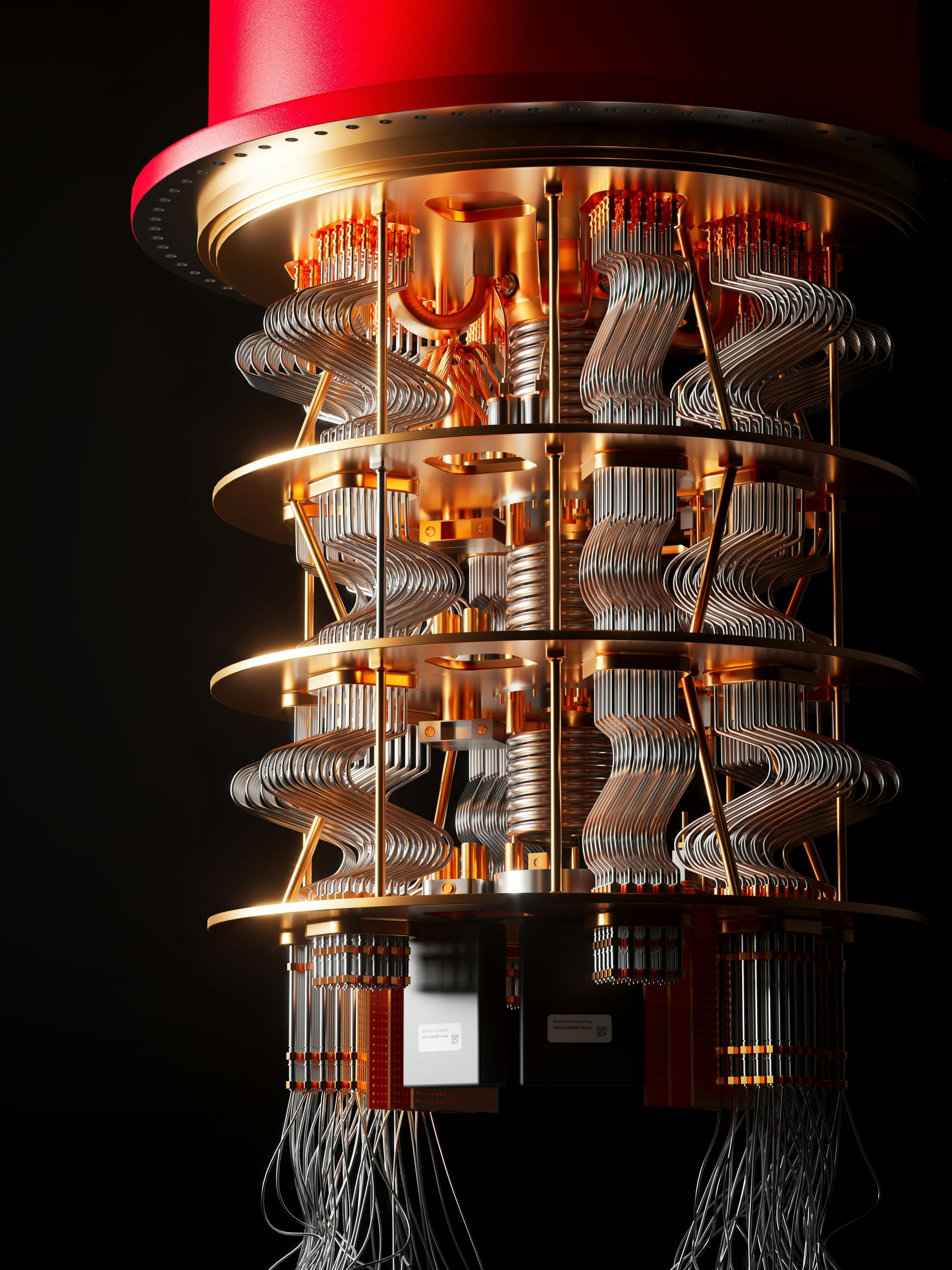
 Photo by Rock'n Roll Monkey on Unsplash
US Risks Losing the Quantum Race Without Urgent Workforce Development
By Jonathan Reichental | 6 min read
Momentum in quantum computing hinges on a skilled, diverse workforce. Without accelerated development, the U.S. risks falling behind global rivals. Gaps exist in talent pipelines, security training, and quantum-ready software; urgency for curricula and apprenticeships. Public-private coordination on curricula, funding, and incentives is needed to prevent brain drain. Talent strategy will determine America's quantum readiness.
 Photo by Blogging Guide on Unsplash
How HashKey plans to become Hong Kong's first crypto IPO
By Cointelegraph | 6 min read
HashKey plans to take a leading Hong Kong crypto exchange public, aiming to become the city's first crypto IPO. Even with a more open regulatory environment than mainland China, HK regulators require robust disclosures, investor protections, and strong custody controls. The move signals growing institutional interest in crypto in Asia and could spark further listings and crypto-adjacent offerings in the region. HashKey faces ongoing scrutiny over anti-money-laundering controls, capital requirements, and market risk, which could influence timing and pricing. If successful, the IPO could set a benchmark for future crypto listings in Asia while underscoring regulatory uncertainty that remains a headwind.
 Photo by Solen Feyissa on Unsplash
AI Agents Debate Mathematical Reasoning
By TechXplore | 5 min read
A new study explores how AI agents can argue and reason about mathematical problems, using debate to surface weaknesses in automated reasoning. The experiments show that adversarial or collaborative debates between agents can improve accuracy and expose counterexamples that single agents miss. The work highlights the importance of structured tool use, chain-of-thought reasoning, and external knowledge bases for robust math reasoning. Despite gains, the research also reveals limits: even advanced agents can produce brittle proofs, require careful validation, and may struggle with abstract reasoning. The findings point to a path where multi-agent debate complements human mathematicians, helping to prototype solutions faster while ensuring reliability.
🌙 NASA - Best Photo from Last Week
Sagittarius B2 Molecular Cloud: A Star-Forming Powerhouse
NASA, ESA, CSA, STScI, Adam Ginsburg (University of Florida), Nazar Budaiev (University of Florida), Taehwa Yoo (University of Florida); Image Processing: Alyssa Pagan (STScI)
The Mid-Infrared Instrument (MIRI) on NASA’s James Webb Space Telescope captured glowing cosmic dust heated by very young massive stars in unprecedented detail in this image of the Sagittarius B2 (Sgr B2) molecular cloud released on Sept. 24, 2025.
Sgr B2 is the most massive, and active star-forming region in our galaxy, located only a few hundred light years from our central supermassive black hole. While Sgr B2 has only 10% of the galactic center’s gas, it produces 50% of its stars. Astronomers want to figure out why it is so much more active than the rest of the galactic center.
MIRI has both a camera and a spectrograph that sees light in the mid-infrared region of the electromagnetic spectrum. MIRI’s view reveals colorful stars punctuated occasionally by bright clouds of gas and dust. Further research into these stars will reveal details of their masses and ages, which will help astronomers better understand the process of star formation in this dense, active galactic center region.
Image credit: Image: NASA, ESA, CSA, STScI, Adam Ginsburg (University of Florida), Nazar Budaiev (University of Florida), Taehwa Yoo (University of Florida); Image Processing: Alyssa Pagan (STScI)
Disclaimer: None of the content in this newsletter is meant to be financial advice. Please do your own due diligence before taking any action related to content within this article.